
Brett Bothma: From Mid-Stage Withdrawal to the Cape Epic Finish Line
Updated: Aug 27
Most riders will tell you the Cape Epic is one of the hardest things they've ever done. Like many on the start line, Brett isn't a professional athlete. He's a husband, father, Kiwi, and balances a demanding full-time career alongside his training. Yet he signed up for exactly that reason: "Doing a challenge few have done."
What followed wasn't a smooth journey to the finish. A two-hour mechanical on Stage 1 contributed to dehydration and a medical withdrawal on Stage 2. Many riders would have accepted that their race was over. Instead, after being medically cleared, Brett returned to the start line, adjusted his strategy, and finished what he came to do.
"I knew I had the mental toughness to complete this race."

-
The Approach
Brett's preparation was built around progressive, structured training that could adapt to real life. Over nine months, the focus was on developing the fitness and mountain bike-specific endurance needed for a multi-day stage race, while adjusting the programme around work, family and life outside training.
The goal was simple: arrive at the start line confident, prepared and ready for the demands of the Cape Epic.
As Brett's journey showed, preparation doesn't guarantee a perfect race. But it can give you the fitness and confidence to adapt when things go wrong.
-
What was your motivation for entering the Cape Epic?
Doing a challenge few have done.
How did you train and prepare—both physically and mentally?
I followed the program and relied on my years in triathlon to get me through the tough times.
Did you have any specific goals or times in mind, or were you just focused on finishing?
Focused on finishing.
You had to stop on Stage 2 because of health issues. What happened?
I was medically withdrawn due to dehydration about 30 km into Stage 2. On Stage 1, we lost more than two hours to a mechanical and ran out of fluid just 3 km before an aid station. Despite doing my best to recover overnight, I never fully recovered before the start of Stage 2, and the dehydration caught up with me.

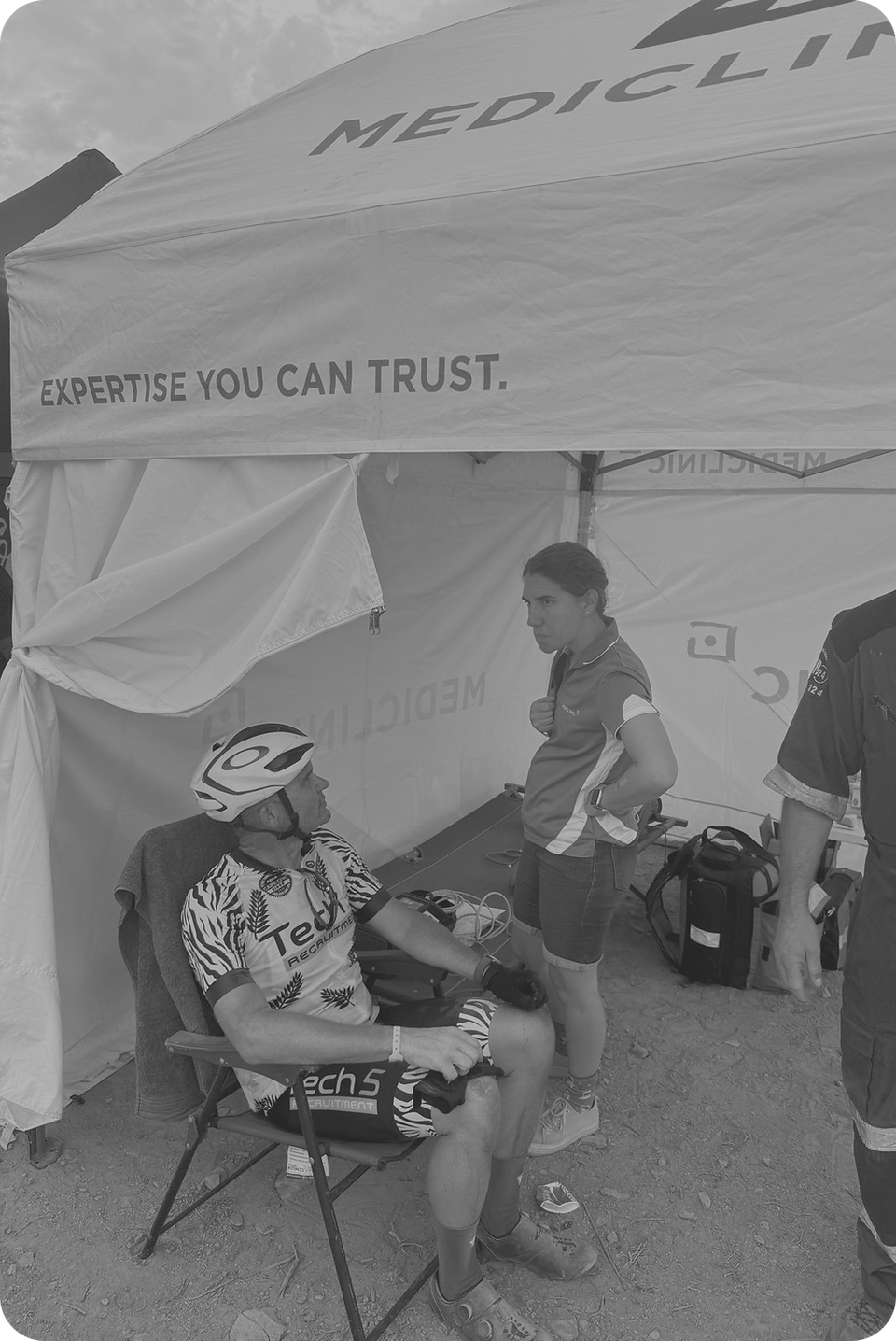
After being medically cleared, what was it like to line up again for Stage 3?
I was pumped to be back in the race. I can overcome challenges very quickly.
How did you adapt your pacing, strategy, or expectations after that setback?
I upped my fluid intake. I started in the last group each day from then on, so the pace was much slower than I would normally ride.
What was the toughest part after returning, and how did you manage fatigue?
Due to the slower pace, I recovered very quickly. The fatigue was more body aches from a fall. My legs were fine, and I had no soreness after each stage.
Did you face any other setbacks?
One crash on Stage 3. I only realised how sore I was when lying on my side after the stage. Mind over matter for this race.
-
Coach's Perspective
This is where the real story lies.
Read back through the answers and notice how casually the setbacks are described: a two-hour mechanical, dehydration severe enough to force a medical withdrawal, a return to racing, and then another crash. There are no excuses or dramatic recounts—just solutions.
That's one of the defining traits of experienced endurance athletes. They don't waste energy wishing things had gone differently. They accept the situation, adapt their plan, and keep moving forward.
The Cape Epic rewards fitness, but it also rewards resilience. Brett demonstrated both.
-
What was the most inspiring or rewarding moment?
Stage 6, awesome trails in Banhoek and the flow they provided. Also, sleeping in a bed once we reached Stellenbosch.


How did reality compare to your expectations? What would you do differently?
I expected it to be hard. I would change my start time on the prologue—ride earlier in the cooler conditions to allow more time to rehydrate and recover for Stage 1.
What did you learn about yourself?
Nothing, to be honest. I knew I had the mental toughness to complete this race.
What advice would you give a first-time Epic rider?
Train hard and recover well. Follow a program, but enjoy life at the same time. Celebrate the milestones during your preparation.

Would you come back? Why or why not?
Yes, I would. Next time I'll bring support and sleep in a bed every night.
Anything else to share?
Train hard, it's worth it!
-
Coach's Closing Reflection
One answer stood out more than any other:
"Nothing, to be honest. I knew I had the mental toughness to complete this race."
Most athletes come away from the Cape Epic saying they discovered something new about themselves. In Brett's case, the race confirmed what was already there.
What makes this story so compelling isn't just the setbacks—it's the way they're described. A two-hour mechanical, dehydration that led to a medical withdrawal, a return to racing, and a crash are all treated as problems to solve rather than reasons to stop. There's no drama, only determination.
For many riders, the Cape Epic is a once-in-a-lifetime opportunity. Not every race goes to plan, and very few are without setbacks. But when it's medically safe to continue, success isn't always defined by the results sheet.
Sometimes it's about honouring the months of preparation, the sacrifices, the support of family and friends who made the journey possible, adapting when things go wrong, and refusing to let one bad day define the entire experience.
The finish line marks the end of the race. The results become a statistic.
The journey is remembered for life.
-
Images courtesy of riders.
-